
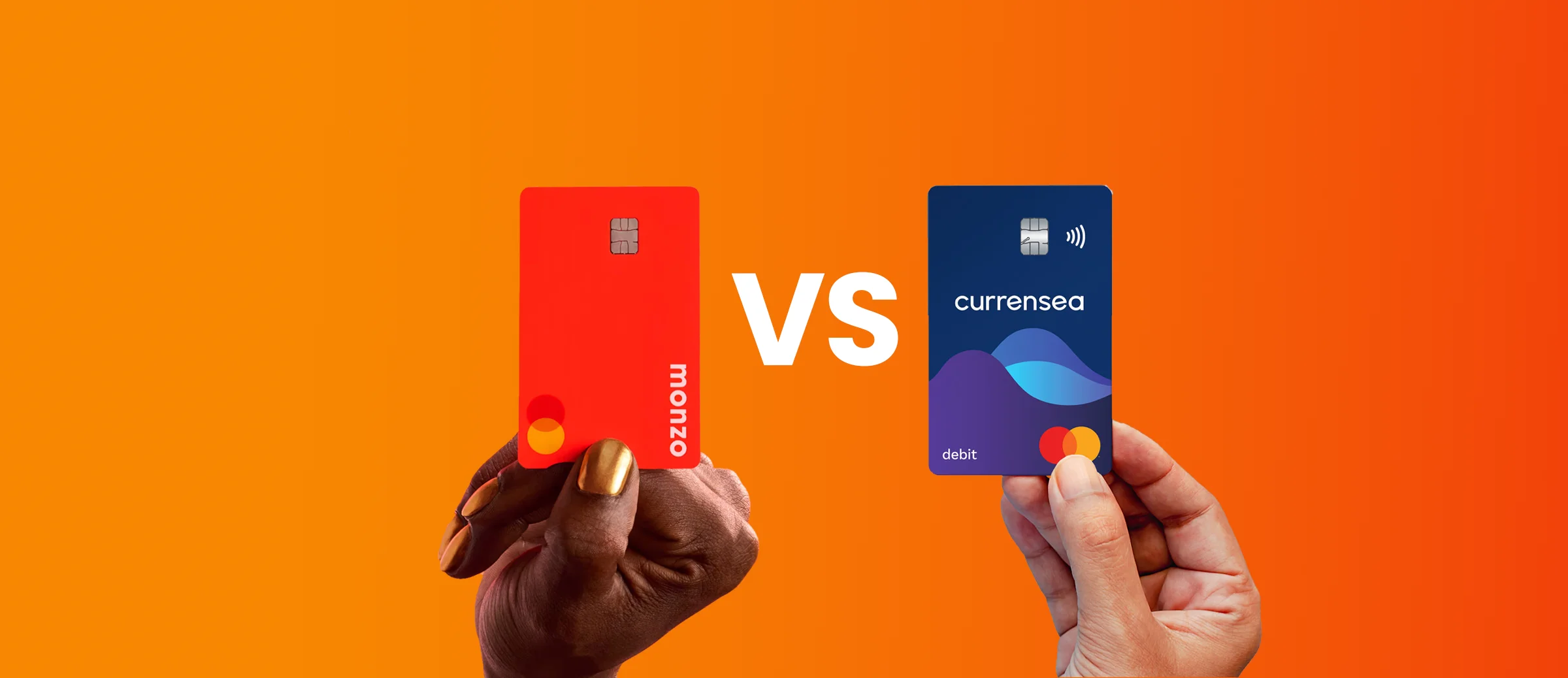
If you want simplicity and convenience, Currensea is hard to beat. It connects directly to your UK bank account and adds just a 0.5% markup on foreign transactions with no need to preload money.
Monzo, on the other hand, offers a full-featured bank account with better budgeting tools and is arguably cheaper when spending across popular currencies.
I’ve used both of these on my travels around Europe and beyond, and while it might be a bit of an apples to oranges comparison, both can do the job for you whilst travelling abroad. Let’s break down how they compare.
| Feature | Currensea | Monzo |
|---|---|---|
| Foreign Transaction Fees | 0.5% markup | Fee-free (Mastercard rate) |
| ATM Withdrawals Abroad | £200/month free, then 3% | £400 every 30 days in EU, £200 elsewhere, then 3% |
| Card Type | Debit card linked to your existing bank account | Full UK current account with debit card |
| App Features | Basic card controls | Budgeting, saving pots, notifications, credit |
| Who it’s best for | Anyone wanting a no-fuss travel card | Everyday banking with travel in mind |
Currensea Overview
Currensea is a UK-based travel debit card that plugs directly into your existing bank account via Open Banking. Launched in 2020, it was founded to solve one simple problem: expensive and opaque foreign-exchange fees on holiday spending.
Rather than making you preload a separate ‘travel wallet,’ Currensea lets you spend in local currency direct from your main UK bank account. This spending is at the interbank rate plus a flat 0.5 % markup. there’s no weekend surcharges, no monthly fees, and no hidden tiers.
By focusing solely on transparent, low-cost spending abroad, Currensea offers a streamlined alternative to multi-feature banks—making it a compelling choice for anyone who just needs a simple, fair-priced travel card.
Monzo Overview
Monzo is the UK’s leading “challenger” bank, with over 12m customers across the country. Funnily enough, its first product was actually a pre-paid travel card, until it gained its fully banking licence in 2017.
Monzo now offers a fully featured current account, complete with budgeting tools, savings “pots,” and real-time spending notifications. You get a contactless Mastercard debit card, plus an array of in-app features designed to help you manage your money both at home and abroad.
Account Type & Sign up
Currensea
Type: Prepaid “travel” debit card that links via Open Banking to your existing UK current account.
Sign-up: KYC and account linking take under 5 minutes in the app; physical card arrives in 5–7 working days.
Requirements: Must hold a UK-regulated current account; no minimum balance or pay-in required.
£10 free cashback
Sign up for a free Currensea card via our link, and you'll get £10 cashback when you use your Currensea card abroad and spend £100.
Monzo
Type: Fully regulated UK current account with Mastercard debit card.
Sign-up: App-based onboarding (ID check and selfie) takes about 10 minutes; you can spend immediately with a virtual card.
Requirements: None for Standard; to unlock fee-free travel perks, you need £1,000 monthly pay-in.
Consider Monzo - free £10 bonus
If you join Monzo via our link below you'll get a free £10 bonus if you make a card transaction within 30 days of signing up.
It doesn't have to be Premium, even free accounts are eligible for the bonus
Overall Currensea is quicker to sign up if you already have a UK bank account; but Monzo gives you a standalone account with broader functionality and instant virtual-card access. Both have sign up bonus offers, but Monzo’s £10 can be spent immediately.
Foreign Transaction Fees
Currensea
Markup: Flat 0.5% on the interbank rate for every transaction, 7 days a week.
Transparency: No hidden weekend surcharges or tiered pricing.
Example: A €100 purchase costs £84.28. A $500 spend in the US would cost £372.02. A ฿15,000 spend in Thailand would cost £342.26
Monzo
Markup: 0% markup up, uses Mastercard exchange rate.
Transparency: Weekend/Off-cap Fees: Weekend surcharge only applies if you exceed your free-spend cap.
Example: A €500 spend costs £420.15. A $500 spend would cost you £370.45 , and spending ฿15,000 in Thailand would cost £342.37
On the 27 May 2025 the European Central Bank rate was 1 GBP = 1.193175 EUR. Currensea offered 1.1865, and Mastercard 1.190051.
On smaller spends in popular currencies the difference is between the two is negligible, and even on more exotic currencies like the Thai Baht, where the Mastercard rate is 1.38% than the interbank rate, there’s not much in it.
Monzo starts to come into its own on larger spends in popular currencies such as the euro. Few will be spending in the 10,000s but if you did, a €10,000 spend via Monzo would be £25 cheaper. Probably not significant enough to be the defining factor in your choice.
ATM fees and limits
Monzo offers fee free ATM withdrawals up to £400 in the UK and EEA, and £200 elsewhere, but if you use Monzo as your main account that £400 limit becomes unlimited. unfortunately the £200 for the rest of the world still applies.
Monzo considers it your main account if you either paid in over £500 in the last 35 days and have an active direct debit, or DWP or student loan payments into your account during this period.
Currensea limits fee free ATM withdrawals to a flat £200 anywhere in the world. If you exceed this you’ll be charged an additional 3% fee.
Most of us will spend directly via our cards when travelling abroad especially in the EU, but if you are someone that likes to withdraw cash, Monzo wins out (just) against Currensea here.
Replacement Cards
These days ApplePay and GooglePay is norm for many of us, but if you do lose your card and need a replacement, differences between the two accounts start to show.
Monzo offers up to two free replacement card in the UK, but charges £30 for a replacement card abroad.
Currensea charges a flat £5 fee for a replacement card no matter where in the world you lose it.
Unfortunately, neither Currensea nor Monzo offer in-app virtual cards on their free accounts. That means if you do lose your card, you’ll need to freeze it immediately within the app and won’t be able to use mobile or other payments.
For this reason, I always suggest you have one or two back up accounts/cards to use until you can get a replacement.
Which one is right for you?
Currensea excels for short holidays and business trips, where simplicity matters most. It’s ideal for those who currently bank with a mainstream High Street bank (Co-op excluded), and don’t want to change or open up another account.
My mum is probably a prime example here. Now inter her 60s and doesn’t want the fuss or hassle of managing another account. I can give her a Currensea card and know she’s getting a great rate when either travelling abroad or just spending online in other currencies.
Monzo shines for extended stays or everyday travel, especially in the Eurozone where ATM limits are completely lifted provided it is used as your main account.
All that being said, both cards are free. Both have a very low barrier to entry, and both offer sign up bonuses (when using my links above) why not carry both?
Other Cards to Consider
If neither Currensea nor Monzo ticks all your boxes, here are two more travel-friendly cards I use regularly that are worth a look:
Trading 212 Debit Card
Best for: Travel cashback 1% and high interest rates 3.8% AER
FX Fee: Interbank rate no mark up.
ATM Withdrawals: £200 /month free, then 3 % thereafter.
Read our full Trading 212 debit card review
Wise Multi-Currency Card
Best for: Travellers who move between multiple currencies and want to hold balances in-app.
FX Fee: Mid-market rate with a small variable fee (typically 0.35 %–1 % depending on currency).
ATM Withdrawals: £200 /month free, then 2 % thereafter.
Get a Wise card here
Looking for more options? See my complete guide to the best credit and debit cards for travel
Frequently Asked Questions
Can I use my Currensea card outside of Europe?
Yes, Currensea works anywhere Visa is accepted, applying the same 0.5% markup on interbank rates globally.
How long does it take to get a Currensea card?
After sign-up and Open Banking link, your physical card is posted within 5–7 working days; you can’t spend until it arrives.
Do I need to top up my Currensea card?
No, Currensea pulls directly from your linked UK bank account at the point of sale; there’s no separate top-up wallet.
Can I get a virtual card with Currensea like Monzo offers?
Not currently, Currensea requires the physical card to be issued before you can spend; there’s no virtual-card option yet. Monzo only offers virtual card on paid plans.
Is there a monthly fee for Monzo?
Monzo’s standard account is free. Paid tiers are available and add perks like fee-free withdrawals without pay-in requirements and travel insurance.
How do I freeze or unfreeze my card?
Both apps let you instantly toggle your card status via their mobile dashboards, no call-centre required.
Are my funds protected with Currensea and Monzo?
Currensea: Funds remain in your bank account (FSCS-protected) until spent.
Monzo: A full-service bank, FSCS-protected up to £85,000 per customer.
Can I receive refunds on both cards?
Yes, refunds post back to your linked account (Currensea) or Monzo balance in the usual settlement times.
Which card is better for long-term travel?
Currensea: Best for short-term trips where simplicity and predictable fees matter.
Monzo: Better if you need an ongoing bank account, budgeting tools, or plan to stay abroad for months (and can meet pay-in criteria).